|
ACIS provides many way to modify models. The functionality for these model modification techniques is implemented in different
ACIS components. These techniques and the code items (functions, classes, Scheme extensions, etc.) that implement them are described in various component manuals.
|
|
|
This chapter introduces some of these model modification techniques and tells you where to look for more information.
|
|
|
Blending
|
|
|
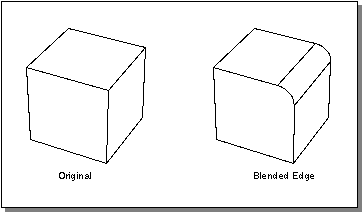
The sharp edges and vertices in models must often be replaced by faces in order to improve the model. This operation is called blending. Blending is used to soften sharp edges and corners and to create smooth transitions from one surface to another. These changes may be needed to make a model more photorealistic, more aesthetically pleasing, safer, stronger (fewer stress points), or physically realizable (easier--or even possible--to manufacture).
|
|
|
Refer to the
Blending Component Manual for more information.
|
|
|
|
|
Figure 9-1. Blending
|
|
|
Booleans
|
|
|
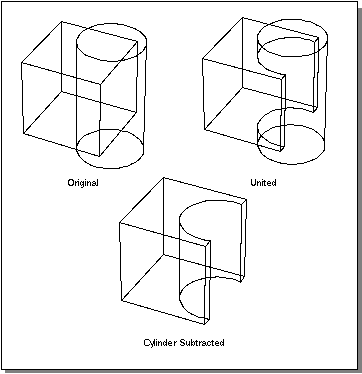
Boolean operations (Booleans) perform the set operations unite, intersect, and subtract on bodies. Booleans operate on model topology. Booleans use intersectors to find intersections between bodies and then decide which pieces to group together and which to discard. A body may be composed of solid, sheet or wire components.
|
|
|
Refer to the
Boolean Component Manual for more information.
|
|
|
|
|
Figure 9-2. Booleans
|
|
|
Covering
|
|
|
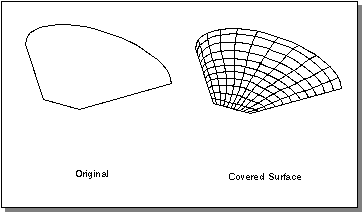
Covering fits a surface over a closed loop of curves (wires); i.e., all the boundaries must be specified. For each wire in the wire body, an attempt is made to calculate a surface which contains all of the edges of the wire. A face is created and the coedges of the wire are made into loops in the face. If a surface can be calculated, it is used for the geometry of the face.
|
|
|
Refer to the
Covering Component Manual for more information.
|
|
|
|
|
Figure 9-3. Covering
|
|
|
Offsetting
|
|
|
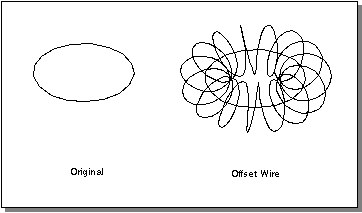
New wires or faces can be created by offsetting from a reference wire body or face. Laws may be used for offsetting.
|
|
|
Refer to the
Offsetting Component Manual for more information.
|
|
|
|
|
Figure 9-4. Offsetting
|
|
|
Skinning and Lofting
|
|
|
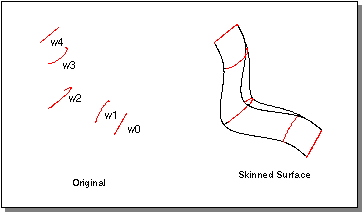
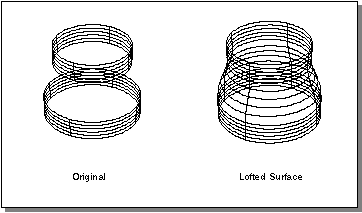
Skinning fits a surface through a series of curves (wire bodies). Lofting starts with a surface and fits another surface through a coedge of the original surface and a series of curves (coedges). Lofting takes into consideration the tangents from the original surface at the first coedge and last curve. Laws may be used for lofting.
|
|
|
Refer to the
Advanced Surfacing Component Manual for more information.
|
|
|
|
|
|
|
Figure 9-5. Lofting
|
|
|
Stitching
|
|
|
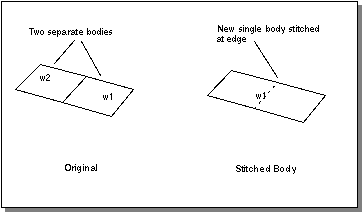
Stitching joins two bodies along edges or vertices that are identical. A stitch is simpler than a Boolean operation because stitching avoids face-face intersections and the evaluation of lump and shell containments. Most of the overhead in a stitching operation is associated with comparing edges to determine if they are entirely identical (coincident) or share some coincident subregion.
|
|
|
Refer to the
Boolean Component Manual for more information.
|
|
|
|
|
Figure 9-6. Stitching
|
|
|
Sweeping
|
|
|
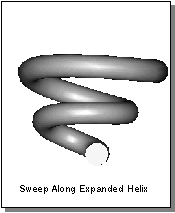
Sweeping creates either a solid body or a sheet body by sweeping the profile, or shape, along a path or along an axis. The profile can be a face, a wire body, a closed group of edges, or an open group of edges. Whereas an open group of edges always results in a sheet body when swept, all other profile instances can result in either a solid or a sheet body. Laws may be used for sweeping.
|
|
|
Refer to the
Sweeping Component Manual for more information.
|
|
|
|
|
Figure 9-7. Sweeping
|