|
The following types of surface intersections may occur:
|
|

|
Transverse junctions (intersections)
|
|
|
Tangential intersections of analytic surfaces
|
|
|
Tangential intersections of spline surfaces
|
|
|
Bounding edges of open surfaces
|
|
|
In transversal intersections, the geometry gaps are filled by extending the adjoining surfaces and recomputing the surface-surface intersections. Refer to Figure 1-6. This handles both analytic and spline transverse junctions.
|
|

|
|
|
Figure 1-6. Transverse Junctions
|
|
|
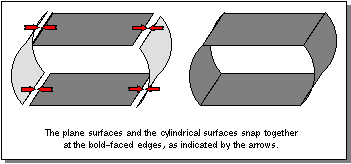
In tangential intersections of analytic surfaces, the surfaces are snapped to each other using linear transformations, including translate, rotate, and scale. The snapping is determined through a graph-based solver that is capable of handling cyclic tangencies. The nodes of the graph are the faces, and the arcs of the graph represent the tangent edges. Cycles in the graph are broken by giving preference to surfaces of higher curvature (e.g., cylinders are snapped to planes rather than planes snapped to cylinders). Refer to Figure 1-7.
|
|
|
|
|
Figure 1-7. Analytic Surface Tangential Intersection
|
|
|
Tangential intersections of spline surfaces in which the intersection curves are along isoparametric lines of the surfaces are corrected via control point modification. Refer to Figure 1-8. Non-isoparametric tangential spline intersections are fit with net surfaces.
|
|

|
|
|
Figure 1-8. Isoparametric Spline Surface Tangential Intersection
|