|
Action:
|
Creates an edge from a spring definition.
|
|
|
Filename:
|
cstr/cstr_scm/edge_scm.cxx
|
|
|
APIs:
|
api_edge_spring
|
|
|
Syntax:
|
(edge:spring axis-point axis-vector
|
|
|
start-position handedness thread-distance
|
|
|
rotation-degrees {[trans-height trans-degrees
|
|
|
thread-distance rotation-degrees]...})
|
|
|
Arg Types:
|
axis-point
|
position
|
|
axis-vector
|
gvector
|
|
start-position
|
position
|
|
handedness
|
boolean
|
|
thread-distance
|
real
|
|
rotation-degrees
|
real
|
|
trans-height
|
real
|
|
trans-degrees
|
real
|
|
|
Returns:
|
edge
|
|
|
Description:
|
This extension links together several helix pieces and transition regions to make one edge. The transition regions between the helix pieces ensure G2 continuity. The final edge consists of a helix followed by zero or more transition/helix pairs.
|
|
|
The
edge returned has information associated with it that indicates where the axis of the helix is located. If the edge is then swept, a rail law is created that orients the profile relative to the center axis, rather than using a minimum rotation rail. This improves the speed of sweeping, and results in the intuitive sweeping of a spring.
|
|
|
All helix and subsequent transition/helix pairs are explicitly listed as parameters. As a minimum, one helix (thread distance and angle) must be specified. After that, any number of transition pieces (height and angle) and helix pieces may be specified, as long as they are specified in transition/helix pairs.
|
|
|
The
axis-point,
axis-vector, and
start-position arguments determine the location of the multi-helix. The radius of the helix is calculated as the distance from the start position to the axis.
|
|
|
The
handedness argument determines the spring direction with respect to the axis vector.
TRUE is right handed, and
FALSE is left handed.
|
|
|
The
rotation-degrees argument determines how far the given spring section rotates about the axis, and can be greater than one revolution (360 degrees). The
thread-distance argument determines the distance between adjacent loops, assuming that the rotation is greater than one revolution.
|
|
|
The
trans-height argument determines the distance for a transition piece, while
trans-degrees dictates the rotation (in degrees) that occurs over the transition piece. Following the transition piece, another rotation section can be specified using
thread-distance and
rot-degrees parameters.
|
|
|
The specification of a transition region and second spring area is optional. When specified, all four parameters
trans-height,
trans-degrees, a second
thread-distance, and a second
rot-degrees are required. Any number of additional transition regions and additional helical sections can be specified as long as the set of all four parameters is given for each section.
|
|
|
Refer to Appendix D,
Spring Scheme Examples, for additional illustrations and Scheme examples.
|
|
|
axis-point,
axis-vector, and
start-position arguments determine the location of the multi-helix.
|
|
|
handedness argument determines the spring direction with respect to the axis vector.
TRUE is right handed, and
FALSE is left handed.
|
|
|
thread-distance argument determines the distance between adjacent loops, assuming that the rotation is greater than one revolution.
|
|
|
rotation-degrees argument determines how far the given spring section rotates about the axis, and can be greater than one revolution (360 degrees).
|
|
|
trans-height argument determines the distance for a transition piece.
|
|
|
trans-degrees dictates the rotation (in degrees) that occurs over the transition piece.
|
|
|
Example:
|
; edge:spring
|
|
; Create axis points.
|
|
; Set the view's eye position, target position,
|
|
; and up vector.
|
|
(define viewset (view:set (position -50 -50 -100)
|
|
|
(position 0 0 0)
|
|
|
(gvector 0 0 1)))
|
|
;; viewset
|
|
(define axis-point (position 0 0 0))
|
|
;; axis-point
|
|
(define axis-vector(gvector 0 1 0))
|
|
;; axis-vector
|
|
(define start-position (position 1 0 0))
|
|
;; start-position
|
|
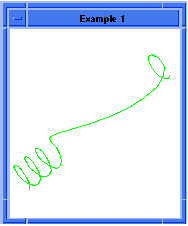
(define spring (edge:spring axis-point axis-vector
|
|
|
start-position #t 0 270
|
|
|
10 360 1 (law:eval "3*360+90") ))
|
|
;; spring
|
|
(define zoom (zoom-all))
|
|
;; zoom
|
|
; OUTPUT Example 1
|
|
|
; Additional Example
|
|
(part:clear)
|
|
;; #t
|
|
; Set the view's eye position, target position,
|
|
; and up vector.
|
|
(define viewset (view:set (position -50 -50 -100)
|
|
|
(position 0 0 0)
|
|
|
(gvector 0 0 1)))
|
|
;; viewset
|
|
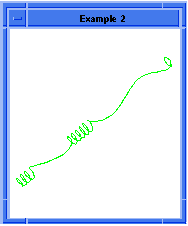
(define spring (edge:spring axis-point axis-vector
|
|
|
start-position #t 0 270
|
|
|
20 (law:eval "2*360") 1 (law:eval "5*360")
|
|
|
10 360 1 (law:eval "3*360+90") ))
|
|
;; spring
|
|
(define zoom (zoom-all))
|
|
;; zoom
|
|
; OUTPUT Example 2
|
|
|
; Additional Example
|
|
(part:clear)
|
|
;; #t
|
|
; Set the view's eye position, target position,
|
|
; and up vector.
|
|
(define viewset (view:set (position -50 -50 -100)
|
|
|
(position 0 0 0)
|
|
|
(gvector 0 0 1)))
|
|
;; viewset
|
|
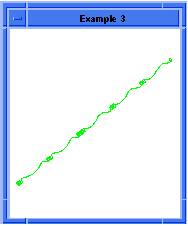
(define spring (edge:spring axis-point axis-vector
|
|
|
start-position #t 0 270
|
|
|
20 (law:eval "2*360") 1 (law:eval "3*360")
|
|
|
20 (law:eval "2*360") 1 (law:eval "3*360")
|
|
|
20 (law:eval "2*360") 1 (law:eval "5*360+90")
|
|
|
20 (law:eval "2*360") 1 (law:eval "3*360")
|
|
|
20 (law:eval "2*360") 1 (law:eval "3*360") ))
|
|
;; spring
|
|
(define zoom (zoom-all))
|
|
;; zoom
|
|
; OUTPUT Example 3
|
|
|
|
|
|
|
|
|
Figure 2-21. edge:spring
|